Can a French Bulldog Recover from IVDD Without Surgery? (2026 Guide)
An acute Intervertebral Disc Disease (IVDD) episode forces French Bulldog owners into a split-second clinical and financial calculation. When specialty neurology centers present estimates ranging from $8,000 to $12,000 for emergency decompressive surgery—often compounded by hidden pet insurance waiting period traps—the core clinical question is immediate: Can a French Bulldog recover from IVDD through conservative management alone?
The objective answer from veterinary neurology is yes—but only within clearly defined neurological parameters. While non-surgical therapy yields predictable success for mild sensory deficits, applying it to advanced spinal cord compression results in permanent, irreversible loss of ambulation.
Here is the exact clinical protocol for non-surgical recovery, real-world success rates by neurological grade, and the irreversible thresholds where emergency surgical referral is mandatory.
1. The 5-Grade IVDD Severity Scale: Clinical Qualification
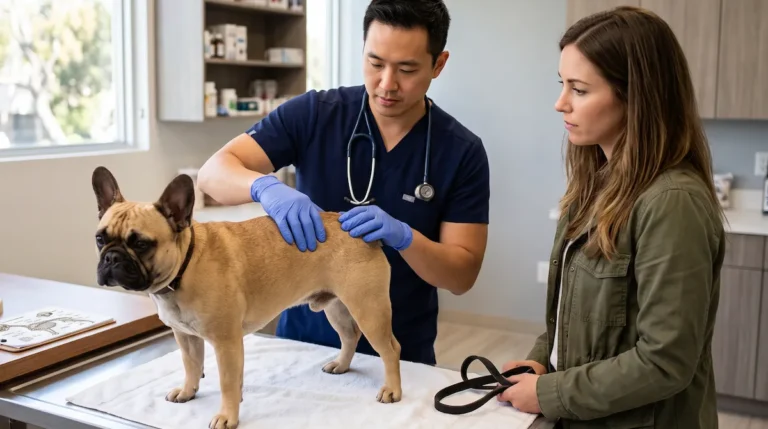
Veterinary neurologists triage Hansen Type I disc herniation using a strict 5-grade staging scale. Eligibility for conservative treatment depends entirely on your dog’s current neurological presentation, not the level of visible distress:
| IVDD Grade | Neurological Presentation | Conservative Success Rate | Surgical Success Rate | Clinical Recommendation |
|---|---|---|---|---|
| Grade 1 | Spinal hyperesthesia only; arched back, neck guarding, reluctance to pivot; normal motor function | ~95% – 100% | Rarely Indicated | Strict Conservative Confinement |
| Grade 2 | Ambulatory paresis; ataxia (“drunken” hind-end gait), proprioceptive knuckling, retains ability to walk | ~80% – 85% | ~95% | Conservative Candidate (Requires continuous rechecks) |
| Grade 3 | Non-ambulatory paresis; cannot support body weight, hind legs collapse; deep pain perception intact | ~50% – 60% | ~90% – 95% | Surgical Boundary (High probability of recurrence) |
| Grade 4 | Paraplegia; zero motor function in pelvic limbs, neurogenic bladder; deep pain perception intact | < 30% | ~85% – 90% | Emergency Decompression Indicated |
| Grade 5 | Paraplegia; Absence of Deep Pain Perception (DPP) for <24–48 hours | < 5% | ~50% (If operated within 24 hrs) | Immediate Surgical Emergency |
Non-Negotiable Threshold: If a French Bulldog progresses to Grade 4 or Grade 5, conservative management ceases to be a viable medical choice. The loss of conscious pain sensation indicates ascending/descending spinal cord ischemia. Decompressive hemilaminectomy within 24 hours remains the only clinical pathway to preserve spinal cord viability.
2. The Conservative Protocol: The Two Non-Negotiable Pillars
Conservative therapy is not casual home rest or crate relaxation. It is a strict 8-week biomechanical stabilization protocol designed to allow the ruptured annulus fibrosus to develop dense fibrocartilaginous scar tissue around the extruded disc mass.
Pillar 1: The 8-Week Strict Confinement Protocol
Cartilaginous repair of spinal annular tears requires a biological minimum of 6 to 8 weeks. Relieving restriction prematurely when clinical symptoms decline is the primary driver of fatal disc re-extrusion.
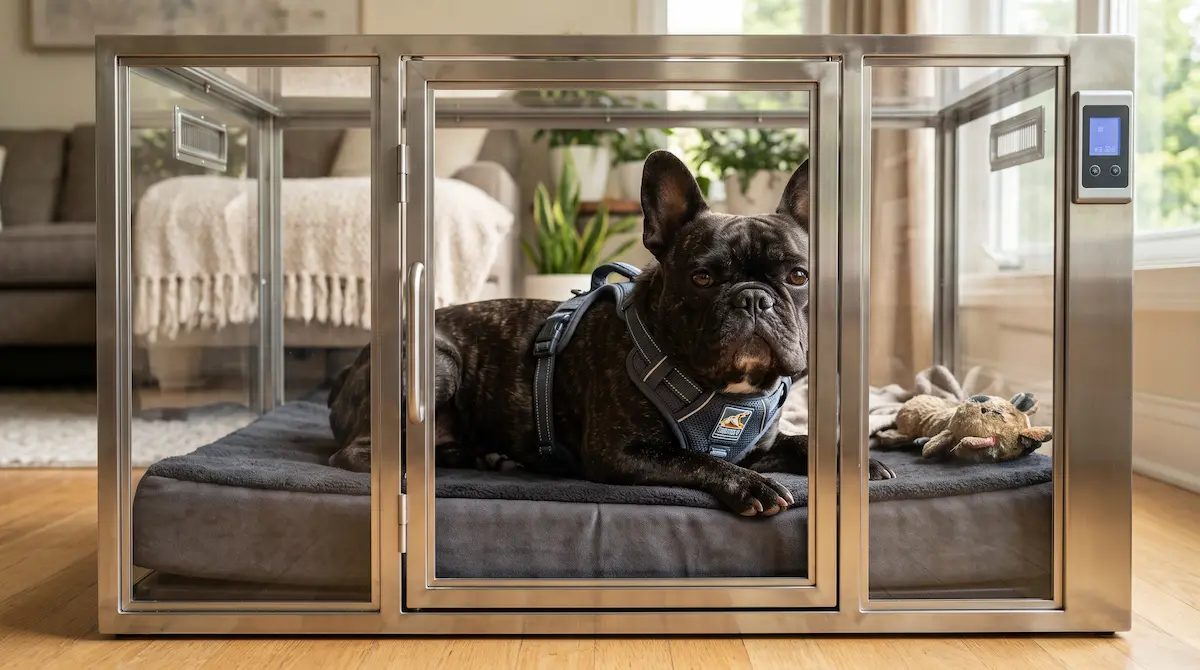
- Crate Footprint: Restrict floor area to approximately 30 x 24 inches—sufficient only for standing, turning, and lateral recumbency. Never utilize open exercise pens, which allow axial rotation, pacing, or barrier climbing.
- Total Environmental Restriction: Zero access to flooring, tile, or outdoor lawns. No ramp use, no couch privileges, and zero weight-bearing navigation around house members.
- Strict Elimination Access: Confinement is continuous (24/7), broken only for 3 to 4 daily leash-controlled elimination trips.
- The Flat Carry Protocol: Transport your Frenchie strictly horizontally (one forearm securing the cranial sternum, the other supporting the caudal pelvis) directly to a grass patch. Keep the leash locked under 4 feet for a maximum of 5 minutes, then carry them straight back into confinement.
- Medical Substrate: Line the crate base with high-density medical memory foam wrapped in waterproof barriers to eliminate decubital ulcers during static posture.
Pillar 2: The Multi-Modal Pharmaceutical Strategy
Medications do not resorb the extruded disc material. Their sole clinical purpose is controlling secondary chemical radiculitis and muscular guarding while the annular tear scars over:
1. Anti-Inflammatory Agents
- NSAIDs (Carprofen, Meloxicam) OR Corticosteroids (Prednisone).
- Fatal Interaction Warning: Never combine NSAIDs and systemic steroids. Concurrent administration induces lethal gastrointestinal ulceration and intestinal perforation. A mandatory 5-to-7-day washout window is required when transitioning between these classes.
2. Neuropathic Pain Inhibitors
- Gabapentin: Dosed every 8 hours to inhibit dorsal horn central sensitization and suppress severe neuropathic pain.
3. Centrally Acting Muscle Relaxants
- Methocarbamol: Abolishes sustained paraspinal spasms secondary to acute mechanical nerve root impingement.
4. Therapeutic Neuro-Sedation
- Trazodone: Indicated for high-drive, anxious Frenchies. Physical agitation and barking against crate wire introduce destructive shearing forces directly into the unstable vertebral motion segment.
3. Week-by-Week Recovery Phases
- Weeks 1 – 2 (Acute Inflammatory Phase): Absolute confinement. Therapeutic dosing of anti-inflammatories, gabapentin, and methocarbamol. Target: resolving acute neuro-inflammation and preventing mechanical displacement of unstable disc material.
- Weeks 3 – 4 (The Deceptive Improvement Window): Analgesia successfully masks clinical discomfort; the dog attempts to stand, jump, or play. The underlying annular defect is unhealed—held together only by fragile fibrin. Action: maintain identical confinement boundaries; do not taper pharmaceuticals without clinical evaluation.
- Weeks 5 – 6 (Fibrocartilage Organization): Neurological evaluation (proprioceptive positioning and spinal palpation). Graduated pharmaceutical tapering under veterinary direction. Gentle passive range-of-motion (PROM) protocols initiated strictly inside the enclosure.
- Weeks 7 – 8 (Controlled Re-Mobilization): Controlled 5-minute flat-surface leash walks introduced. Installation of permanent domestic barrier modifications prior to room release.
4. Financial Audit: Conservative Therapy vs. Decompressive Surgery
While conservative management avoids emergency operating room costs, it carries distinct clinical expenses. Comprehensive care requires repeated spinal reassessments, continuous pharmacy refills, follow-up imaging, and long-term rehabilitation:
| Clinical Cost Category | Conservative Care (8 Weeks) | Surgical Hemilaminectomy |
|---|---|---|
| Emergency Triage & Diagnostics | $400 – $900 (Bloodwork & Spinal Radiographs) | $3,500 – $5,000 (Spinal MRI or Myelo-CT) |
| Surgical Decompression | $0 (Non-Surgical) | $5,000 – $7,500 (Hemilaminectomy / Fenestration) |
| Pharmaceutical Management | $300 – $600 (NSAIDs, Gabapentin, Trazodone) | $400 – $700 (Post-surgical multimodal pain control) |
| Veterinary Recheck Exams | $300 – $600 (Bi-weekly clinical progress checks) | Included in surgical package / $300 |
| Secondary Physical Therapy | $600 – $1,200 (Class IV Laser & Hydrotherapy) | $1,200 – $2,500 (Full neurological rehabilitation) |
| Total Realized Cost | $1,600 – $3,300 | $10,100 – $15,700 |
| Subsequent Relapse Risk | 30% – 40% | < 10% (At operated disc site) |
For an itemized review of specialty hospital invoice charges, consult our companion clinical guide on French Bulldog IVDD surgical costs and neurological grading.
5. The Relapse Factor: Why 30%–40% Recur
The fundamental limitation of conservative care is anatomical: the extruded disc volume remains within the vertebral canal. While clinical swelling subsides and the nucleus pulposus undergoes progressive dehydration, the physical mass continues to reside adjacent to the spinal cord.
Any subsequent uncontrolled torque, furniture jump, or stair impact can re-extrude calcified disc fragments.
Following completion of the 8-week confinement protocol, the home environment must permanently shift to an Enforced Spinal Protocol:
- Stair Restrictions: Permanent child safety barriers across all stair runs.
- Mandatory Bed/Couch Ramps: High-traction rubberized ramps secured beside all elevated domestic furniture.
- Strict Elimination of Neck Collars: Transition exclusively to broad, sternum-distributing harnesses to prevent cervical torque.
- Body Condition Scoring: Maintain strict body conditioning (BCS 4/9). Excess abdominal mass imposes continuous tensile strain across the thoracolumbar junction (T12–L3).
6. Neurological Red Flags: Immediate Surgical Conversion
Monitor your dog continuously throughout conservative confinement. Transport your French Bulldog to an accredited emergency specialty facility immediately upon detecting any of the following signs:
- Loss of Deep Pain Perception: Clamping a toe digit with hemostats produces zero conscious behavioral response (no vocalization, head turn, or attempt to bite).
- Neurogenic Bladder Distension: Inability to express urine, hard distended bladder wall on palpation, or unconscious urinary dribbling.
- Acute Motor Progression: A Grade 1 or 2 dog collapses into non-ambulatory recumbency within a few hours.
- Refractory Breakthrough Pain: Continuous vocalization, tremors, or arched rigid posture despite maximum therapeutic doses of gabapentin and anti-inflammatories.
Establishing Protection Prior to Neurological Onset
If your French Bulldog has never presented with paraspinal pain, limb knuckling, or cervical guarding, this represents the critical window to secure policy coverage. Once spinal symptoms are recorded in medical notes, underwriters designate all future vertebral pathology as pre-existing, eliminating reimbursement for both medical hospitalization and neurosurgery.
To compare waiting periods, bilateral spinal exclusions, and direct-pay veterinary structures across top underwriters, review our audited analysis of the top 3 best pet insurance plans for French Bulldogs.