
French Bulldog IVDD Crate Rest: Week-by-Week Recovery Timeline (2026)
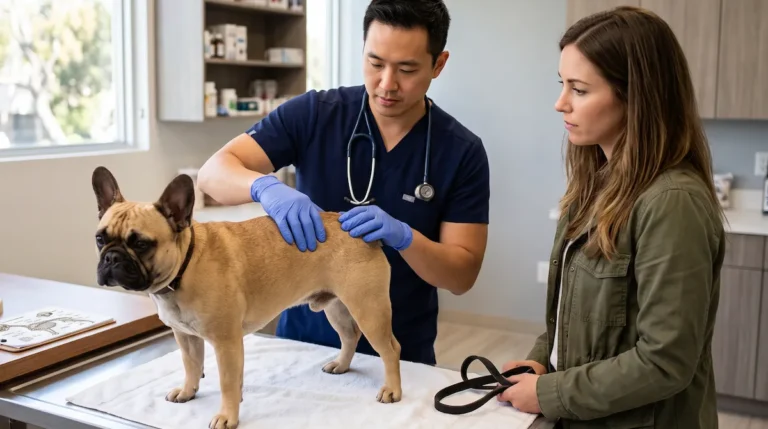
When a French Bulldog receives an early-stage Intervertebral Disc Disease (IVDD) diagnosis, strict crate rest serves as the frontline medical intervention. While Grade 4 and Grade 5 spinal compressions typically demand emergency decompression surgery, Grade 1 (pain only) and Grade 2 (mild ataxia or wobbly gait) cases often enter conservative medical management. To evaluate whether your dog qualifies for non-surgical healing across Grades 1–5, consult our clinical guide on recovering from IVDD without surgery.
The term “crate rest” is frequently misunderstood. It is not casual indoor confinement; it is a rigid, non-negotiable immobilization protocol designed to let the outer fibrous ring (annulus fibrosus) form a stable scar over the ruptured disc material. For an in-depth clinical breakdown of disc herniation grading, review our French Bulldog IVDD guide.
1. The Core Rules of Conservative Management
The spinal disc requires 6 to 8 weeks of continuous, undisturbed scar-tissue formation. Allowing a recovering dog to take even a single leap off a sofa or scramble across slick hardwood can instantly turn a low-grade disc bulge into a catastrophic spinal cord transection.
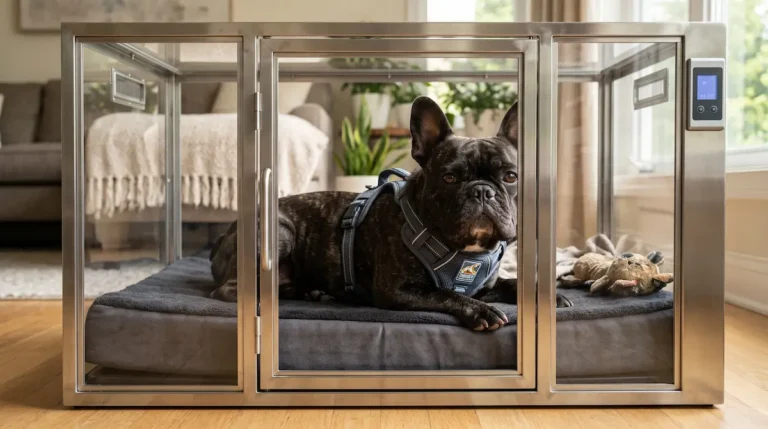
- 100% Confinement: The dog remains inside the crate 24 hours a day, 7 days a week, excluding brief, handheld leash outings for elimination.
- No Free Roaming: Closed puppy playpens that allow running or pacing are unacceptable. The crate should only be large enough for the dog to stand up, turn around comfortably, and lie flat.
- Orthopedic Support: Use a supportive, dense memory foam mattress that keeps the spine straight and prevents pressure sores. Avoid loose, lumpy bedding that causes uneven spinal twisting.
- Two-Handed Horizontal Lifting: Never pick up an IVDD dog by the armpits. Always scoop with one hand supporting the chest and the other fully cradling the pelvis to keep the spine entirely horizontal.
2. Week-by-Week IVDD Recovery Timeline
A successful conservative recovery demands patience. Even when anti-inflammatory medications relieve initial pain, the underlying disc remains mechanically weak.
| Phase | Clinical Objectives | Daily Mobility Restrictions |
|---|---|---|
| Weeks 1–2: Acute Inflammatory Stage | Suppress nerve swelling, control pain, prevent further disc extrusion. | Strict crate confinement. Carry dog outside exclusively for potty breaks using a support sling. Zero walking. |
| Weeks 3–4: Scar Stabilization | Fibrous scarring begins over the torn disc; pain subsides substantially. | Maintain 100% confinement. Do not allow roaming even if the dog acts completely cured. |
| Weeks 5–6: Controlled Re-Mobilization | Controlled tissue maturation; prevent muscle atrophy and joint stiffness. | Begin short, 3-to-5-minute slow leash walks on flat grass only. No stairs, ramps, or slippery floors. |
| Weeks 7–8: Gradual Reintegration | Veterinary re-evaluation, slow return to modified household life. | Crate confinement transitions to small, gated, carpeted rooms. Lifetime jumping ban begins. |
3. Daily Nursing & Potty Protocol
Elimination breaks represent the highest-risk window for re-injury during conservative care.
- The Support Sling Method: Place a wide sling (or a dry bath towel folded lengthwise) beneath the dog’s abdomen, just forward of the hind legs. Hold the handles upward to bear 50% to 75% of the dog’s rear weight, eliminating compressive downward torque on the lumbar spine.
- Grass Footing Only: Carry your Frenchie directly to a flat patch of grass. Slippery tiles, damp decks, and concrete edges can trigger accidental slips.
- Immediate Return: As soon as urination and defecation occur, praise the dog calmly, scoop them up horizontally, and return them straight to the crate.
- Bladder Monitoring: Dogs experiencing neurological deficits may suffer from urinary retention. Monitor urine volume daily; if the bladder feels hard and round like a baseball, consult your veterinarian immediately for manual expression.
4. Medication Precautions: The False Sense of Security
Veterinarians typically prescribe a combination of pain relievers (such as Gabapentin) and anti-inflammatory drugs (NSAIDs like Carprofen, or corticosteroids like Prednisone).
Crucial Warning: Never administer NSAIDs and corticosteroids concurrently. Doing so triggers life-threatening gastrointestinal perforation.
Medications mask pain within 48 to 72 hours. When the pain disappears, Frenchies naturally attempt to bounce, play, or scratch their ears. Owners frequently misinterpret this pain relief as a complete cure and relax crate confinement prematurely. The disc is still unhealed; removing confinement early leads directly to acute secondary relapse.
5. Recurrence Rates & Financial Protection
Conservative management saves thousands of dollars up front, but it does not remove the underlying degenerate disc material. Clinical studies show that 30% to 40% of French Bulldogs managed conservatively experience a recurrent IVDD episode within their lifetime.
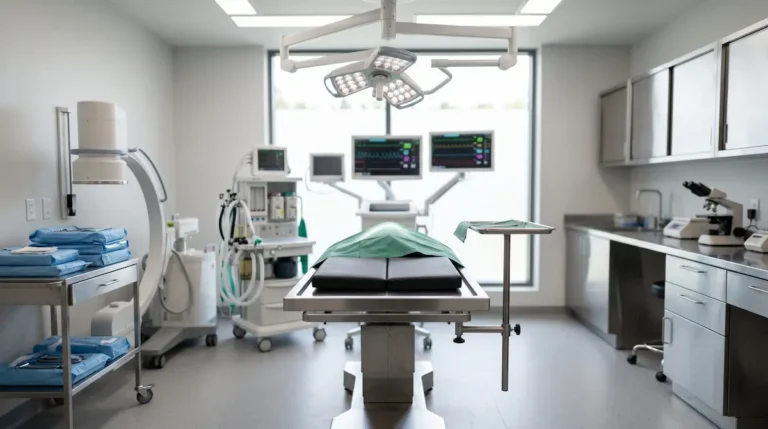
When a relapse occurs, it frequently bypasses mild pain and presents as acute Grade 4 or Grade 5 paralysis requiring emergency surgical hemilaminectomy ($8,000 to $12,000, including advanced MRI diagnostics).
If a dog experiences an IVDD episode before an insurance policy is active, the entire spinal column is permanently classified as a pre-existing condition, leaving the owner fully exposed to catastrophic future surgical bills. To safeguard your financial stability and guarantee your pet emergency access to specialized neurological care, compare the best pet insurance for French Bulldogs. Selecting an underwriter with comprehensive spinal and congenital illness coverage early ensures lifelong security before symptoms strike.